
Alarms or CCTV cameras? Which is better?
If you’d like to install an alarm or CCTV system in your home or business, we’ll offer you impartial advice free of charge to help you choose the best option at the best price.

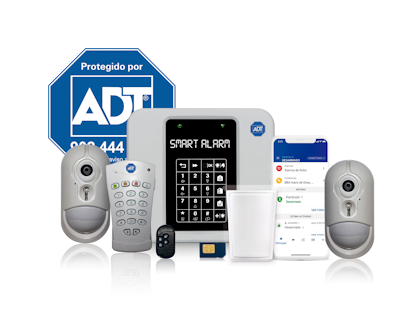


We work with the leading alarm companies and compare across every offer on the market


Differences between an alarm and a CCTV camera
The main function of an alarm is to trigger an alarm signal and alert the monitoring centre, the police and the user when an intrusion occurs, so that immediate action can be taken to prevent theft or unauthorised entry.
However, a CCTV camera does not trigger an alarm when it detects an intrusion, nor does it connect to a monitoring centre or the police. Its function is limited to recording what has happened over a specific period of time, so that the user can later verify the events and have evidence of them.
Alarm system with video detectors: the perfect combination.
Alarms with video detectors are a hybrid of an alarm and a camera, offering the advantages of both systems.
You can also install an alarm system and supplement it with cameras that record continuously, but in most cases (particularly in homes) it will be sufficient to install an alarm system with video detectors.
When the alarm is triggered, the monitoring centre connects to the cameras so that they can check what is happening and take appropriate action, as well as sending an alert and a video to the user via the alarm company’s app.
They also allow the user to request a video at any time, without the need for an alarm to be triggered. These requests consist of short video clips, lasting around 10 seconds, which are used to check that everything is in order, or, conversely, to see if anything out of the ordinary is happening.
Broadly speaking, the aim is to enable us to see what is happening in our home or business in real time, quickly and easily, so that we can tell whether it is a false alarm or a genuine break-in.
Why choose an alarm system with a video detector?
Alarm systems with video detectors offer a number of advantages over surveillance cameras. Let’s look at some of them.
- An alarm is far more effective at preventing a burglary or break-in than a camera, as an alarm is a reactive measure; in other words, it reacts actively to an intrusion by setting off the siren and contacting the security monitoring centre, which will then alert the police so that they can attend the home or business.
- An alarm acts as a greater deterrent than a CCTV camera. There are several reasons for this: on the one hand, when you sign up for an alarm system linked to the police, deterrent signs are installed outside to warn that the home or business is protected by an alarm; and on the other hand, burglars and squatters know that if the alarm is triggered, the siren will sound and the police will arrive within minutes, whereas if there are only cameras, no one will come, and the only thing they’ll have to worry about is covering their faces so as not to be identified.
- They provide legally admissible evidence. In the event of a trial for burglary or squatting, video recordings are only admissible if they have been made by equipment installed and monitored by an accredited security company, as this ensures compliance with regulations regarding the safekeeping (and non-tampering) of evidence. Recordings made by private systems, on the other hand, are not usually accepted as evidence because there is no guarantee that they have not been tampered with.
- Alarm systems have batteries that allow them to continue operating in the event of a power cut, unlike most CCTV cameras.
Would you like to install security cameras in your business?
To improve security in businesses, it makes more sense to install CCTV cameras, as they help to monitor the business (both staff and customers), prevent theft or robberies whilst the business is open, and provide legal evidence in the event of any kind of theft or criminal act.
With advances in technology, continuous recording camera systems have become more popular, affordable and easy to install in recent years. Wi-Fi cameras, CCTV and video surveillance are just some of the options available.
However, it is important to bear in mind the Data Protection Act and the Private Security Act, which have become stricter in recent years, and the authorities are very strict on this matter.
You can install CCTV cameras in a business, but, amongst other measures, you will need to notify your employees in writing that you have these cameras and which areas are under video surveillance; put up notice signs in visible locations displaying the company’s details so that members of the public can exercise their right to have recordings deleted; and register the CCTV system with a data protection organisation that provides legal support for the installation.
PLEASE NOTE: The processing of images must comply with the requirements regarding the protection of personal data, as set out in the Organic Law and, in particular, Instruction 1/2006 of the AGPD (Spanish Data Protection Agency).
We therefore recommend that you outsource and contract both alarm systems and continuous CCTV recording systems to an accredited security company that will take care of everything and assume legal responsibility for the installation and the recordings.

Are Wi-Fi cameras safe?
Wi-Fi-connected security cameras are undoubtedly very popular, affordable, easy to install and offer good image quality.
However, are these cameras safe?
Wi-Fi cameras have some major security issues:
- They are highly vulnerable to attacks using frequency jammers.
- These images cannot be used as evidence in court. The only evidence admissible in court is that captured by the cameras of an alarm system connected to a Central Monitoring Station (CRA), installed by an approved security company.
- They depend on the range of the Wi-Fi signal, which isn’t usually very strong, so we’ll have to run cables – which is a weak point, as ‘the bad guys’ can disable it simply by cutting the cables.
- We will always be dependent on the internet signal, which may fail if there is a power cut, or if there is a fault in the cabling in the telecoms cabinet, etc.
- They are vulnerable to hacking. Cyber-attacks are a daily occurrence, and ‘hacking into’ a Wi-Fi network is not something you only see in films – quite the opposite, in fact. There have already been cases of large-scale hacks of Wi-Fi cameras that were streaming live video to websites:

Search for an invoice
We just need your latest bill so we can analyse your current usage.

We speak with you
In a free 5-minute call, an adviser will show you the best options on the market.

Start saving
We take care of the entire process, and you start saving automatically.

